AI guesses project facts
It may invent a service, route, schema, or architecture because the answer sounds familiar from training data.
Learn
Think of Kiyo as the onboarding guide, safety checklist, workflow router, and verification reminder that an AI must read before helping in your codebase. Claude Code is the native-first host. Codex, GitHub Copilot, and OpenCode CLI remain compatible.
It may invent a service, route, schema, or architecture because the answer sounds familiar from training data.
A small fix can turn into a broad refactor when scope is not explicit.
A response can say fixed or tests pass even when no build or test command ran.
Too many similar-sounding commands make it easy to reach for the wrong one for the job.
First project flow
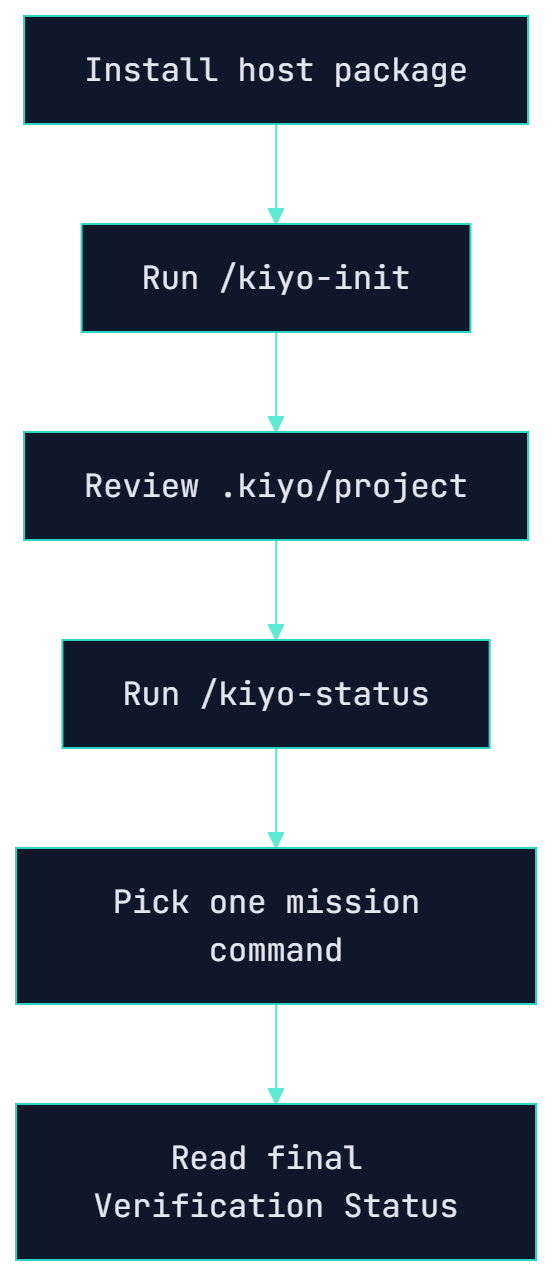
Start with initialization. After that, every mission should read the generated project facts before it reads source code.
Core ideas
A project-local folder of facts the AI must read first.
.kiyo/project/ is created by /kiyo-init. It records structure, detected architecture, conventions, testing patterns, working rules, and onboarding notes.
One request should become one bounded job.
Kiyo separates broad requests into a current mission plus deferred follow-ups. This keeps diffs reviewable.
The risk level for the task.
standard is normal focused work. strict requires approval planning. deep is read-only by default.
The honest final status of a code-changing task.
Allowed values are Verified, Implemented but not verified, Not verified, and Could not verify.
A Markdown role contract, not a background service.
Kiyo currently ships 8 Specialist Agent contracts: architect-planner, audit-specialist, legacy-specialist, migration-specialist, performance-investigator, refactor-surgeon, security-reviewer, and test-writer.
A discipline rule the host applies from prompt context.
Auto skills cover no hallucination, existing pattern first, token-efficient context, surgical change, runtime verification, compact response, and more.
Without Kiyo discipline
With Kiyo discipline